|
|||||||||||
|
|||||||||||











| My Horses
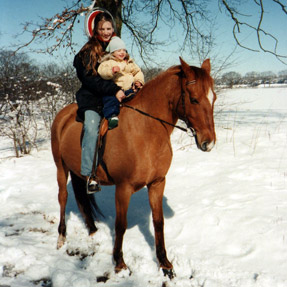
When she was four years of age I finally started to ride her and moved to a larger stable, which was also frequented by a lot of dressage riders. I did however get fed up with that sport right after my very first competition. The judge called me to her desk after my dressage test and told me I would never get anywhere with this small, poorly built horse whose gait was so badly developed. “You’d better sell that pony quickly” was her advice. I have to confess I am quite grateful to this judge today. She didn’t exactly have the most educationally sound way to deal with children, but she did change my way of thinking. I haven’t once participated in a competition since then; instead I discovered the Renaissance of the Art of Riding when I met Bent Branderup many years later who accepted me as a regular student. He never once commented on Sanambour’s poor exterior. I learnt a lot from her during my apprenticeship and she made me experience a lot of magic moments. |
 |
Pura Raza Española (PRE) Elegido
(b. 1994) After I had bought Elegido he started to show signs of restlessness when he met mares in the stable or in pasture. That is why I decided to have him castrated. I have never regretted this decision since he is a very sensitive, almost hysterical horse who will certainly have a more peaceful life as a gelding. Soon I moved to Bent’s stables to start my work as a trainer. Elegido has been learning the Renaissance of the Art of Riding all the way together with me, from the first work on the ground to the high level of education today. As in Guérinière’s times he used to be trained with a cavesson during ground and longe work, then continued with a combination of cavesson and curb. After his gymnastic training had so far advanced that I was able to perform one-handed all the side movements (“versal” and “traversal”) in walk, trot and collected canter with him, I went on to introduce him to the side saddle. After seven years of training Elegido has perfected almost all the airs on the ground. Thank God, practicing all these lessons in a beautiful state of Losgelassenheit never ends. (It would be too boring to work in a constant state of perfection, or, to quote Guérinière: “Perfection kills grace”.) My plans for Elegido are to master all the airs on the ground in the side saddle as well as astride and ultimately perform the “levade” both ways. This has become a purpose in life for both of us. |
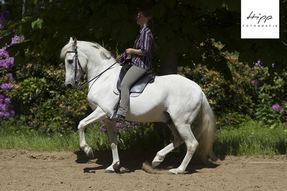
Piaffe 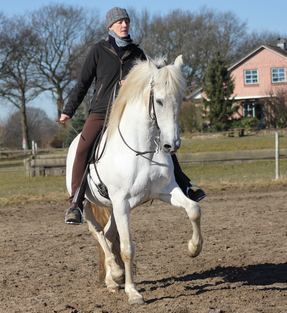
Passage Traversale |
Frederiksborg Stallion Regulus Martell (b.
1998): Regulus is a Frederiksborg horse with a beautiful exterior: a long swan-like neck, a short strong back, nicely angled hindquarters and a little Roman nose. He does have a rather special character on top of that, being pretty wilful and extremely self-confident. In other words: I like him. Like Elegido he is trained in the Renaissance of the Art of Riding, being particularly focused on the canter. After teaching him the half steps, that is the bending of the haunches leading to the piaffe, I started cantering him as he is especially talented for that. So now he is learning all the side movements (“versal” and “traversal”), the pirouettes and the flying changes. It will take his haunches at least another year to become supple enough for the piaffe, but time is not important in this context – it is all about respecting the horse’s possibilities, about collectively working on a project that enhances the horse’s strength and health and on top of that means fun for the two of us. |
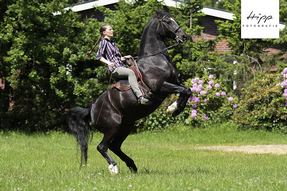
Courbette |